
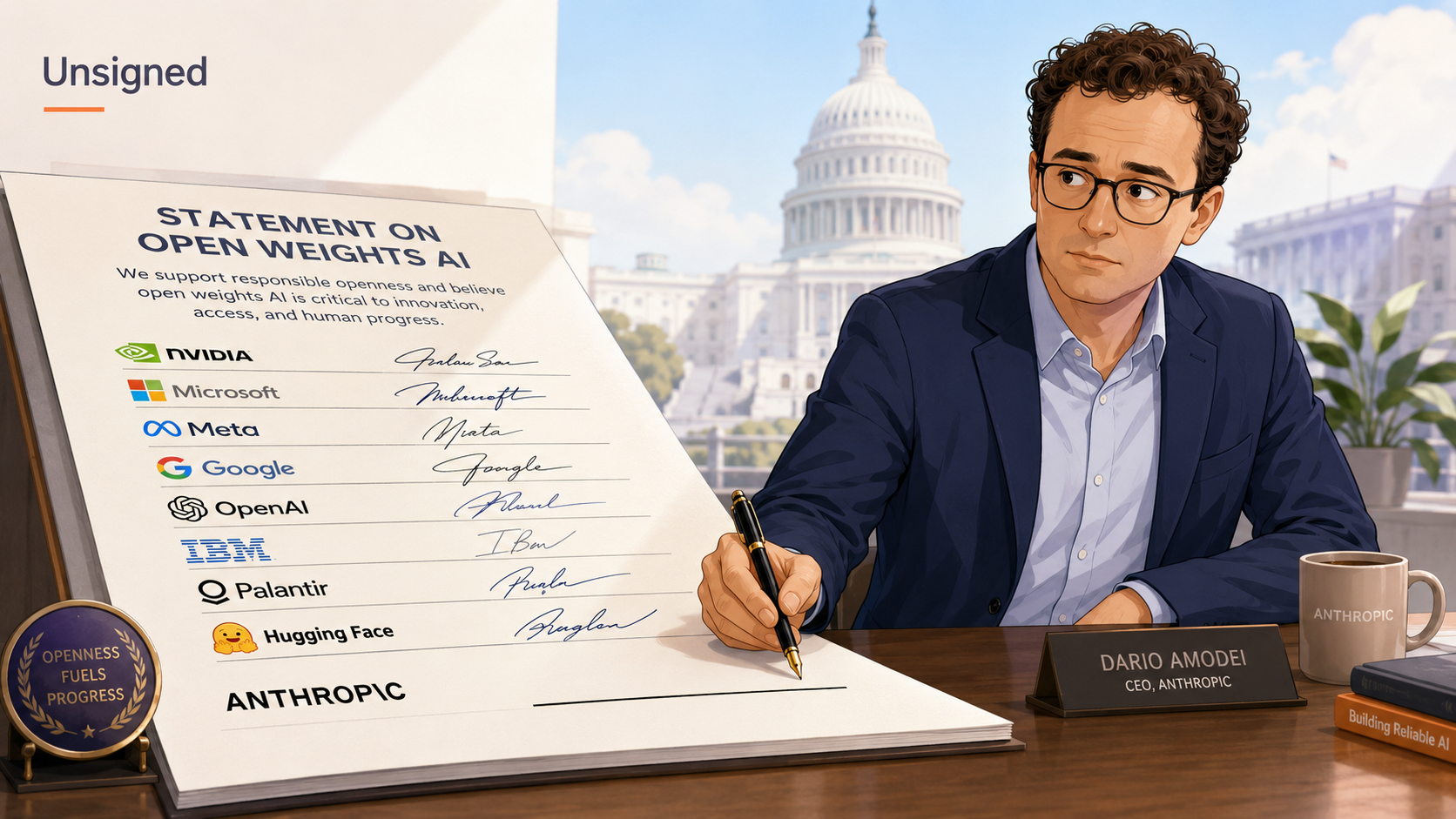
Dario Amodei published a blog post today denying that Anthropic wants an open source AI ban, days after Anthropic became the most visible holdout among major AI labs from a 25-company industry letter opposing new restrictions on open weight models. He’s careful to say he agrees open weight models can be a public good, but he never signed that letter, and he still pushes back hard on its core argument that open weights make AI safer. He’s threading a needle here, and it’s worth asking whether that middle ground actually holds up.
The blog post is titled “Our position on open-weights models,” and it reads like a direct answer to a very specific accusation. Reports emerged last week that the Trump administration is considering restrictions on Chinese open weight models, most notably Kimi K3 from Moonshot AI. In response, Nvidia’s Jensen Huang used his first-ever post on X to share a letter called “Open Weights and American AI Leadership,” backed by 25 companies including Microsoft, Meta, IBM, Palantir, and Hugging Face. OpenAI added its name to the list within hours. Anthropic, along with Google, did not.
That absence mattered, because Anthropic was the last major closed-model lab standing outside the letter, and it stood to benefit commercially if Washington restricted its open weight competition. Some read the silence as confirmation that Anthropic wanted the ban quietly, without having to say so in public.
Amodei’s post pushes back on that directly. He states outright that Anthropic has never advocated for banning open weight models “as a category,” and calls models without dangerous capabilities a genuine public good. He agrees with parts of the letter too, including the idea that open weight models expand access and strengthen competition. Where he draws the line is on safety. He rejects the letter’s argument that open weight models make cyber defenders safer than attackers, and he says a ban on Chinese models specifically wouldn’t solve his actual concern, since legitimate US businesses aren’t the threat he’s worried about.
His real concern, as he lays it out, is authoritarian governments, specifically the Chinese Communist Party, building AI systems more powerful than anything the US produces and using that advantage for military dominance or domestic repression. His second, smaller concern is that powerful models of any origin get misused for cyberattacks or bioweapons research. Instead of a ban, he’s proposing three narrower moves: tighter export controls on advanced chips going to authoritarian governments, a crackdown on large-scale distillation, the technique Moonshot has been accused of using to copy US models, and mandatory safety testing that applies to open and closed models alike.
Reaction has split roughly down predictable lines. Critics, including a Washington Examiner op-ed, argue this is regulatory capture wearing a safety costume, pointing back to Amodei’s own history at OpenAI in 2019, when he was part of the team that withheld GPT-2’s weights over safety concerns that never fully materialized. On Reddit and Hacker News, the top comment threads on his past statements read some version of the same joke: a guy who runs a closed AI company doesn’t want free competition, and nobody’s shocked. Trump AI advisor David Sacks has made the regulatory capture accusation directly at the industry’s closed labs. On the other side, mainstream coverage from Axios and CNBC has largely treated the post as a genuine attempt to narrow the disagreement rather than a dodge, noting Amodei is trying to separate “no blanket ban” from “no safety rules at all.” Notably, the sharpest internal pushback on the original letter came from inside Anthropic itself, from a staff researcher who criticized it before Amodei’s post even went up.
Nothing here has actually changed in Washington. No ban exists, no legislation has been introduced, and the chip and distillation policies Amodei is asking for don’t exist yet either. What’s happened so far is a public argument conducted entirely through blog posts and X threads, with the actual policy outcome still undecided.
Follow What I’m Building With AI
A practical dispatch on the AI news worth knowing, the tools I’m testing, and the real lessons from projects I’m building in public. Plus occasional interactive workshops when there’s something worth exploring together.
Free to join. Unsubscribe anytime.
FAQ
Does Anthropic want to ban open source AI models?
No. Dario Amodei’s blog post explicitly states Anthropic has never advocated for banning open weight models as a category, though he does support tighter chip export controls, distillation restrictions, and mandatory safety testing.
What did Dario Amodei say about open weight AI?
He called open weight models without dangerous capabilities a public good, but disagreed with the industry letter’s claim that open weights make AI safer, and he did not sign the letter itself.
Why didn’t Anthropic sign the open weights letter?
Anthropic disagreed with the letter’s argument that open weight models inherently benefit cyber defenders over attackers, and Amodei’s stated concerns center on authoritarian governments rather than open weight models generally.



Leave a Reply