

The Claude Opus 5.5 vs GPT-6 Sol matchup arrived on a single Tuesday, with the two launches landing roughly 90 minutes apart. Both companies led with the same pitch: more capability for less money. Anthropic says its new Opus matches the pricier Fable 5.1 while costing 40% less to run than the model it replaces. OpenAI answered with two cheaper GPT-6 models, Sol and Luna, at about half the API price of their predecessors. On paper, that looks like a price war. Whether the models live up to the launch posts is a question the launch posts can’t answer.
What Anthropic released: Claude Opus 5.5

Claude Opus 5.5 is the first model in Anthropic’s new Claude 5.5 family. Opus is the top tier of Anthropic’s everyday lineup, sitting above Sonnet and Haiku, with only the Fable and Mythos tier above it.
Anthropic says Opus 5.5 performs at the level of Fable 5.1 on most work, which stands out because Fable is the more expensive model. The price has come down as well. Opus 5.5 costs $4 per million input tokens and $20 per million output tokens, compared with $5 and $25 for Opus 5. Tokens are the small chunks of text an AI model reads and writes, and they’re how developers pay to use it. Anthropic also says the new model is faster and more token efficient, meaning it needs fewer tokens to finish the same task.
Some of the changes are about how the model communicates. According to TechCrunch, Opus 5.5 is less likely to use jargon and more likely to put the important information at the start of its replies.
Anthropic’s own examples are ambitious. The company says one early tester completed a 680,000 line code migration in less than a day, and that when asked to speed up page loads across a web app, Opus 5.5 succeeded 39 times out of 40. Those results come from Anthropic and its chosen testers, not from independent reviewers.
The release matters beyond pricing too. It’s Anthropic’s first model since CEO Dario Amodei called for pacing the frontier, which means deliberately slowing capability gains so safety work can keep up. Anthropic says external evaluators including METR tested Opus 5.5 before launch. Because its biology and cybersecurity abilities are comparable to the restricted Mythos model, it ships with the same safeguards Anthropic uses on Fable.
What OpenAI released: GPT-6 Sol and GPT-6 Luna
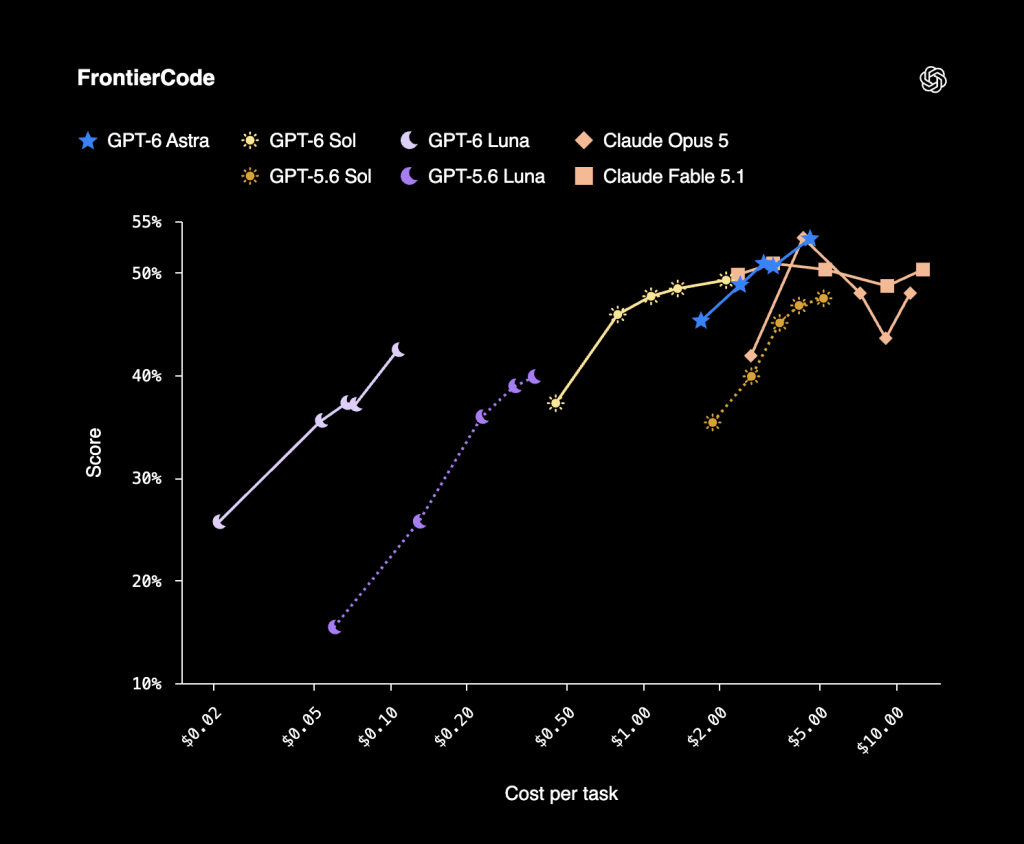
OpenAI followed by adding two models to its GPT-6 family, which began with GPT-6 Astra earlier this month. Astra remains OpenAI’s most capable model, and Sol and Luna are the cheaper tiers underneath it.
GPT-6 Sol is aimed at harder work such as coding and multi step workflows. GPT-6 Luna is built for high volume jobs with a clear goal, like summarizing documents, pulling information out of text, or answering quick questions.
Pricing is the biggest change. Sol costs $2 per million input tokens and $10 per million output tokens, down from $4 and $20 for GPT-5.6 Sol. Luna costs $0.10 and $0.50, down from $0.20 and $1.20. An OpenAI spokesperson told The New Stack that the GPT-5.6 prices were always meant to be promotional, while the new GPT-6 prices are the default.
Sol and Luna are rolling out in ChatGPT Work and Codex for Plus, Pro, Business, Enterprise and Edu subscribers. Free and Go users can use Luna through the ChatGPT desktop app. Neither model was available in the regular ChatGPT chat at launch, and OpenAI said it would expand access gradually through the day. OpenAI also claims GPT-6 Sol makes about half as many mistakes as GPT-5.6 Sol, and more developer news is likely at OpenAI DevDay on September 29.
Claude Opus 5.5 vs GPT-6 Sol: reading the benchmarks carefully
Both companies are selling the same message, and both are using their own numbers to make the case.
OpenAI’s main comparison uses AutomationBench, a test of business workflows across apps. It says GPT-6 Sol at its highest reasoning setting scored 33.2%, against 26.9% for Claude Opus 5 at max effort, at about 9% of the Claude model’s cost per task. That comparison has a timing problem, though, because it measures Sol against Opus 5 rather than the Opus 5.5 that shipped earlier the same day. RuntimeWire also noted that the result depends on the reasoning settings, prices and testing setup OpenAI picked, so it should be read as a vendor benchmark rather than an independent study.
Anthropic’s claims carry the same limitation. The Fable level performance and the 680,000 line migration are Anthropic’s own reported results.
The two models also sit in different slots. Opus 5.5 is Anthropic’s top everyday model, while Sol is a tier below OpenAI’s flagship Astra. A straight head to head doesn’t line up neatly on price or position, so the fair comparison depends on what you actually need the model to do.
As for why both labs cut prices on the same day, CNBC reported that both face stiff competition from cheaper open weight models, which anyone can download and run on their own hardware. Price has become one of the main ways the big labs compete.
Tracking how Claude Opus 5.5 and GPT-6 Sol hold up in real use
Launch day shows what a company says its model can do. The weeks that follow show what it does when people put it to work.
That gap is why we built trackai, The August Dispatch’s AI model release tracker. It logs every release on a timeline alongside the provider’s own claims and published benchmarks, linked to the source. It then pairs those claims with real tests, such as the apps, games, code refactors and automations people build while trying new models and comparing them with rivals. Reports come in three ways: we add some manually, n8n automations pull others in from places like Hacker News, developer forums, YouTube and X, and anyone can submit their own. Every report gets a human review before it’s published.
Claude Opus 5.5, GPT-6 Sol and GPT-6 Luna are already on the timeline. None of them has a reviewed report yet, since they’re only hours old. If you build something with one of them this week, submit it so other people can see how it performs outside the launch post.
FAQ
What is Claude Opus 5.5 and how much does it cost?
Claude Opus 5.5 is Anthropic’s newest top tier Claude model, released on September 22, 2026. API pricing is $4 per million input tokens and $20 per million output tokens, and Anthropic says it costs about 40% less to run than Opus 5.
What’s the difference between GPT-6 Sol and GPT-6 Luna?
Sol is the more capable of the two and is built for complex work like coding. Luna is cheaper and faster, and it’s designed for high volume tasks such as summarizing and extracting information.
Can I try GPT-6 Luna for free?
Yes, with a caveat. Free and Go ChatGPT users can access Luna through the ChatGPT desktop app, though OpenAI was rolling out access gradually on launch day.
Is Claude Opus 5.5 better than GPT-6 Sol?
There’s no independent answer yet. Each company’s benchmarks favor its own model, and OpenAI’s headline comparison was against the older Opus 5. Real world tests over the coming weeks will give a clearer picture.
Follow What I’m Building With AI
A practical dispatch on the AI news worth knowing, the tools I’m testing, and the real lessons from projects I’m building in public. Plus occasional interactive workshops when there’s something worth exploring together.
Free to join. Unsubscribe anytime.
The takeaway
Two of the biggest AI labs shipped more capable models at lower prices on the same afternoon, which is good news for anyone building with them. Which one suits your work is still an open question, and the best evidence will come from what people build next. You can follow along, or add your own test, at trackai.theaugustdispatch.com.



Leave a Reply