

I did not set out to become a vibe coder. I set out to build one thing.
Then it was two things. Then it was a racing game I keep tinkering with because I want the physics to feel just a little more right. Then it turned into Explorer 233, a whole fictional universe I am building from scratch because I finally could. Then, because I needed somewhere to document what was happening to my brain, it turned into this blog.
That is basically the plot of every vibe coder I know. You start with a small itch. You end up thinking in terms of what you can build instead of what you wish existed. Naval Ravikant (co-founder and chairman of AngelList) put it bluntly in a post earlier this year: vibe coding is more addictive than any video game ever made, as long as you know what you want to build.
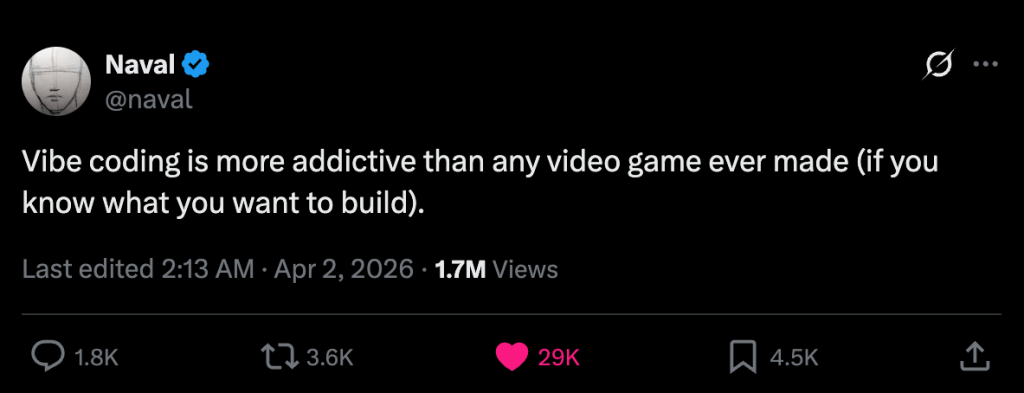
I read that and felt personally called out.
Why Vibe Coding Feels So Addictive
Naval did not stop at the tweet. On the Naval Podcast he explained the mechanism, and it is worth sitting with because it is the reason the addiction feels so different from anything before it. A video game hooks you by feeding you rewards that sit right at the edge of your ability, hard enough to stay interesting, easy enough not to frustrate you. But those rewards are fake, and the game itself is bounded by whatever its creators decided to build into it. Vibe coding runs the same loop, except there is no ceiling. You are not playing inside someone else’s world. You are pointed at an actual Turing machine, so whatever you can describe, you can attempt.
I felt that shift the moment I realized I was not opening my coding tool to finish a task anymore. I was opening it because I wanted to see what would happen next.
What Vibe Coding Actually Is
The term is barely a year and a half old. Andrej Karpathy coined it in February of last year to describe a specific kind of coding where you stop reading the code closely and just prompt, run, and react. It caught on so fast that Collins Dictionary named it Word of the Year for 2025.
But the meaning has drifted a lot since then, and that drift matters for this article. What most people now call vibe coding covers everything from a total beginner prompting their way to a working app, to a senior engineer using an AI agent as a very fast collaborator while still reviewing every line. According to a 2026 breakdown from Taylance Tech, roughly two thirds of people using these tools today are not professional developers at all, which tells you the center of gravity has moved from engineering teams to regular curious people like me and probably you.
How Much Vibe Coding Costs
Here is where I want to push back on the romantic version of this story a little, because I have lived it. Vibe coding is not a free hobby. The tools that produce the polished, premium results people show off online are not the free tier ones.
A recent survey of eight hundred indie builders found the typical vibe coded project runs about eighty seven dollars a month once you count tool subscriptions, hosting, and AI usage, with the heaviest spenders paying well over three hundred. Separate research from The AI Career Lab puts a realistic solo setup, one main AI coding subscription plus basic hosting, somewhere between twenty and forty five dollars a month to start, with anyone running an agent all day on something ambitious climbing toward one hundred to two hundred fifty. That is not registering a domain and calling it done. That is a recurring bill, every month, for as long as you keep building.
The learning curve was the other cost I did not budget for. Even with AI doing the heavy lifting, going from an idea to a working app is not instant if you are not naturally technical. You do not need to start where I did, though. Platforms like Lovable and Replit are built specifically to lower that barrier, trading some control for a much gentler ramp. If Claude Code or Cursor feels like being handed a cockpit on day one, those are worth trying first.
Follow What I’m Building With AI
A practical dispatch on the AI news worth knowing, the tools I’m testing, and the real lessons from projects I’m building in public. Plus occasional interactive workshops when there’s something worth exploring together.
Free to join. Unsubscribe anytime.
Do Professional Engineers Like Vibe Coding
This is the part I was not sure about until I looked into it, and it turns out the disagreement runs deeper than I expected, coming from serious people on both sides.
According to a 2026 state of the industry piece from Kingy AI, Karpathy himself walked the term back within about a year, rebranding his original, narrower meaning as agentic engineering, trying to put distance between the discipline and the looser meaning the internet ran with. Andrew Ng publicly pushed back too, worried the phrase makes people think real engineering is just going with the vibes. The data backs up some of that worry. Research summarized by Hashnode points to a controlled study of experienced open source developers who were measurably slower when using AI tools, and the strange part is they still believed the AI had helped them even after seeing the results. Independent code reviews cited in that same Kingy AI piece found AI generated code carries noticeably more security issues than code written the old way.
But it is not all skepticism. That same Hashnode research found developers with a decade or more of experience report large productivity gains, because they know how to evaluate what the AI produces instead of just trusting it. Even inside Google Cloud AI, the message in a Bloomberg segment is that vibe coding does not spell the end of serious engineering, it just changes what the job looks like day to day.
So the honest read is that vibe coding is not universally good or universally reckless. It depends heavily on whether the person behind the keyboard knows enough to catch what the AI gets wrong. For someone like me, coming at it as a hobbyist and not a professional engineer, that is worth remembering before I trust an output blindly.
Frequently Asked Questions
Is vibe coding actually addictive? People who try it, including Naval and myself, describe a pull similar to gaming: fast feedback, visible progress, and no ceiling on what you can attempt next. Unlike a game, what you build keeps existing after you close the laptop, which seems to make the pull stronger, not weaker.
How much does vibe coding cost per month? For a solo hobbyist project, expect somewhere between twenty and one hundred twenty dollars a month once you include your AI coding subscription and basic hosting. Heavier builders working on more ambitious projects report spending several hundred dollars a month.
Do professional software engineers actually use vibe coding? Yes, though opinion is split right down the middle. Some experienced engineers report major productivity gains, while controlled research has found others working more slowly despite feeling faster. Either way, the people getting the most out of it are the ones who still understand what the AI is doing well enough to catch its mistakes.
The Takeaway
I do not think Naval was exaggerating. Vibe coding scratched an itch I did not know I had, and it built the racing game, Explorer 233, and this very blog along the way. But I would be doing you a disservice if I only told you the fun part. It costs actual money every month, it has a learning curve even with the training wheels platforms out there, and the engineering world is still arguing about whether it is a shortcut or a shortcut with a hidden bill attached.
My take, for whatever it is worth: keep building, but budget for it like the hobby it is, and stay curious about what you do not fully understand yet. That second part is the whole reason this blog exists in the first place.



Leave a Reply