
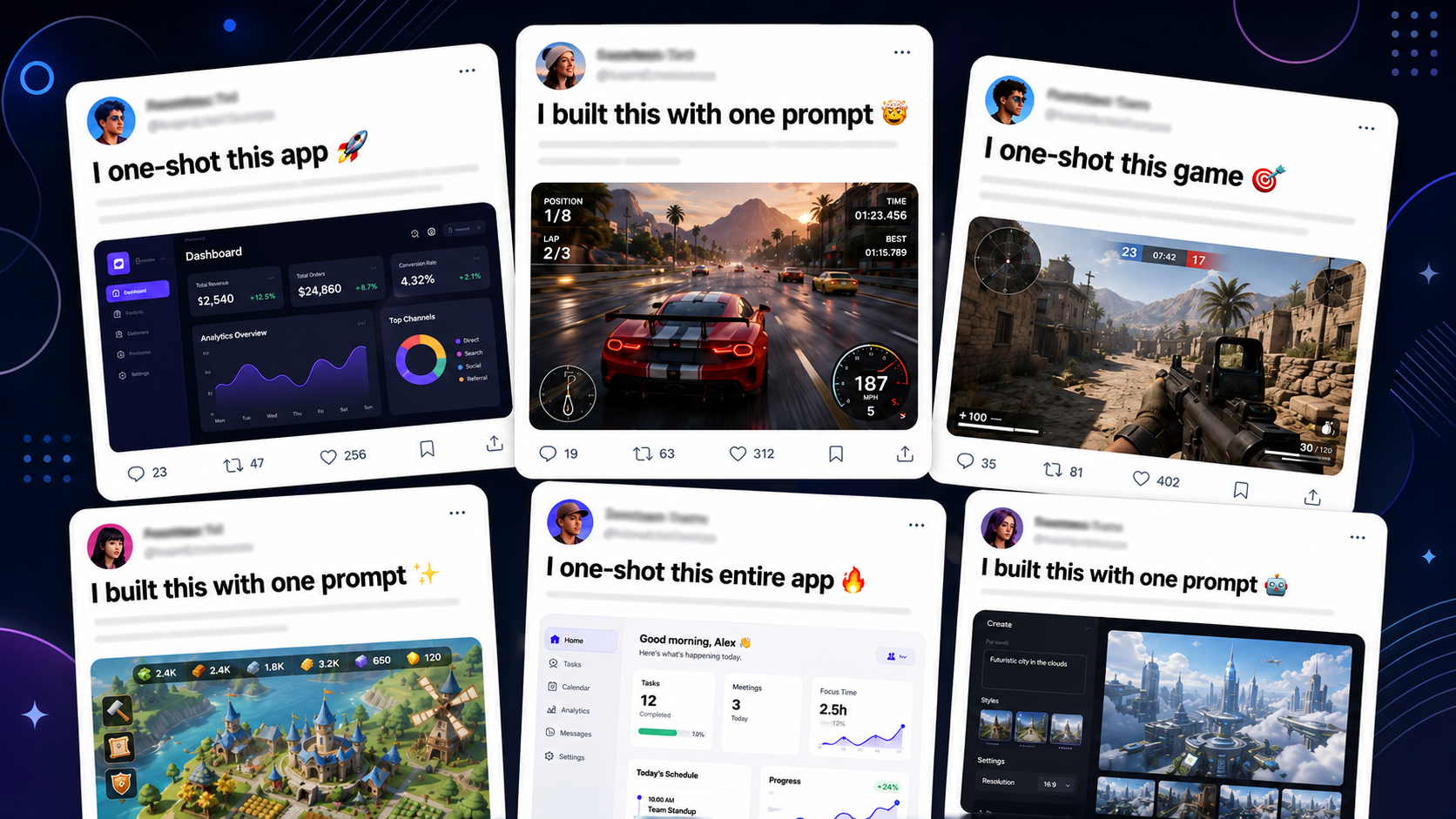
Whenever a new model drops, you see a lot of people posting some insanely cool applications with the caption “I one-shotted this app” or “I built this game with one prompt.” I watch and think to myself, how the hell do you build a fully developed, AAA quality game or app with one prompt? Here’s what I found out. But first, let me give you my usual approach to building things with AI. Spoiler, it’s never been one prompt.
My actual Vibecoding approach
When I started building an app, example my browser based car racing game CHOP FIRST, I didn’t sit down and write one long prompt and walk away. I started by brainstorming the idea itself in Claude, just talking through what I wanted: a fun arcade race where people can race, set a time and send to a friend to beat that time, or race with an Ai driver who trash talks along the way (not audio talk but via a tex bubble). From there I had it give me a first prompt to actually start building, and I iterated from that point, going back again and again to direct it toward more of what I was actually looking for.
Along the way I had to pick up terms I didn’t know, like HUD, for example, which stands for heads-up display (the visual overlay on screen that shows real-time information like health, ammo, or a map). I’m not coming from a traditional game development background, so there’s a real knowledge gap, and staying curious enough to look things up as they come up is what closes it, at least enough to understand the fundamentals of what I’m trying to build.

I had to understand vehicle physics well enough to explain what felt wrong when a car wasn’t driving right, because Claude Code can’t fix what you can’t describe. I learned about importing 3D assets, why some models loaded fine and others broke the scene, and what React Three Fiber actually needed from me to render a track properly. None of that came from one prompt. It came from building something, testing it, noticing what felt off, and going back to fix it. Over and over.

The trend, right on schedule
Every time Anthropic, OpenAI, or Google ships a new flagship model, the same wave shows up on Twitter. Someone posts a screen recording of a fully rendered game or app, captions it “one prompt,” and the replies fill up with disbelief and awe in equal measure.

Anthropic just gave the trend its latest trigger. Opus 5 launched last week, positioned as a model that gets close to the performance of Anthropic’s top tier Fable 5 model at roughly half the cost, with an adjustable effort dial that lets you trade computing power for savings depending on what a task actually needs. It’s the fourth model Anthropic has shipped in under two months, after Mythos 5, Fable 5, and Sonnet 5 all landed in June. Every one of those releases has come with its own round of “look what one prompt did” posts.
What I actually found out
A prompt from AI builder Matt Shumer went viral recently for getting a first person shooter built at Call of Duty quality out of a single message. I read the actual prompt, and it explains a lot more than the headline claim does.

It didn’t just ask for a finished game. It told the model to break the work into sub agents, assign each one a piece of the build, and have a separate sub agent act as a harsh critic checking every part visually against triple A quality. It told the model to keep looping until that critic was satisfied, then run a blind side by side comparison against an actual Call of Duty game and judge which one looked better. It said not to stop until it was, in the prompt’s own words, utterly perfect.
That’s not a demo of one prompt building a game. That’s a demo of a model instructed to run an open ended improvement loop against a bar it can never confirm it has cleared.
A developer named Ziwen tested this for himself and posted what he found. He burned through more than 30 percent of his weekly token allowance on a high tier plan in about 12 hours running the same prompt, and the build itself was real, he confirmed that much. But it was still going. The model kept scoring itself, judging its own output every round, and running another pass of revision instead of ever calling the work finished, because it never actually won the blind comparison against Call of Duty. That’s where the real cost of a ‘one prompt’ build shows up. It’s not zero effort, it’s tokens, and a lot of them. I saw other people running the same prompt hit their session limits entirely, twice over, with the loop still not done. And that cost isn’t the same for everyone. I’m on a Pro tier. Someone running this on a Max tier can let a prompt like that grind for a lot longer before hitting a wall, so two people testing the exact same prompt aren’t even running the same experiment.
So when someone says they built a AAA quality game with one prompt (fyi AAA, also known as triple-A, is a term used to classify video games produced or distributed by a mid-sized or major publisher), what actually happened is closer to this: one prompt set up hours of autonomous iteration, with the model checking, scoring, and rebuilding itself against a really high target. That’s a genuinely interesting way to use these models. It is not the same thing as typing one prompt and iterating till you inch closer to a point of manageable satisfaction.
Prior knowledge is doing a lot of the work
There’s a second factor that matters just as much as the looping trick. A lot of the people posting these one-shot claims are already software engineers. Their “one prompt” carries years of technical vocabulary most people don’t have. They know what to call the specific physics system they want, what rendering engine to reference, what architecture pattern solves the problem they’re describing. That context does a huge amount of work before the model ever generates a line of code.
For someone new to building with AI, that gap isn’t obvious from the outside. You just see the result and assume the distance between your prompt and theirs is small. It usually isn’t.
Why this actually matters
What worries me a little is this: if you’re new to vibe coding and your first prompt for something ambitious doesn’t come back looking like a finished game, it’s easy to conclude you did something wrong, or that the tool doesn’t work as advertised. Neither is true. What you’re comparing yourself to is either a carefully engineered loop that burned a huge amount of tokens, or a prompt written by someone who already had the technical fluency to skip steps you haven’t learned yet.
Real building, at least in my experience, looks a lot less impressive in the moment and a lot more useful over time. You hit a wall, you learn just enough to describe the problem clearly, and you try again. That cycle is where you actually understand what you built, which matters the first time something breaks and you need to fix it yourself.
I’ll be spending time with Opus 5 over the coming weeks the same way I approach every new model: iterating, breaking things, and learning whatever I need to learn to get the next piece right. If a one-shot claim crosses my timeline in the meantime, I’ll read the actual prompt before I believe the caption. That’s usually where the real story is. So, i hate to say it but, like and subscribe? and follow my blog www.theaugustdispatch.com.
FAQ
What does “one-shot prompt” mean in AI coding? A one-shot prompt is a single message meant to produce a finished result without further back and forth. In practice, many viral “one-shot” claims actually involve prompts that instruct the model to loop and self correct many times, which isn’t the same as a single generation.
Can Claude Opus 5 really build a full game from one prompt? It can generate a working starting point from one prompt, but a fully polished, AAA quality game generally requires either an extended autonomous loop with heavy token use, or several rounds of iteration and correction from the person directing it.
Why do AI coding demos on Twitter look better than real projects? Many demos are the result of prompts engineered to run long, self critiquing loops, or come from people with existing technical knowledge that shapes how effectively they can prompt. Both factors are usually left out of the caption.



Leave a Reply