

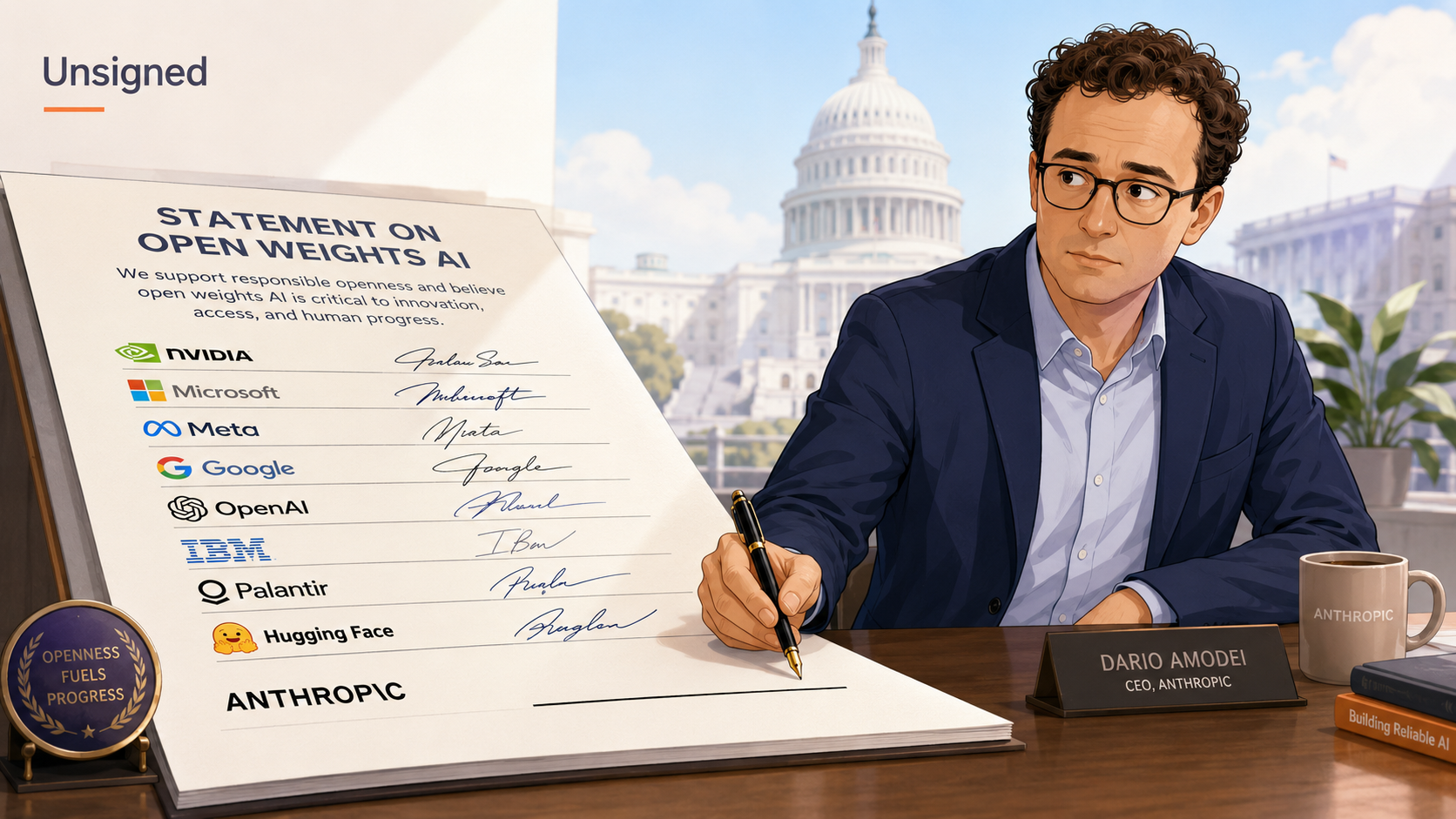
An open source AI ban is now on the table in Washington, and the industry’s response arrived within days. On July 24, 25 companies, including Nvidia, Microsoft, and Meta, signed a joint letter urging policymakers not to restrict open weight AI models. By the end of that same day, OpenAI had joined them too, even though it wasn’t on the original list.
The letter is called “Open Weights and American AI Leadership.” Open weight models are AI systems whose trained parameters are published publicly, so anyone can download them, run them on their own hardware, and modify how they work. That’s different from closed models like the ones OpenAI and Anthropic sell through paid API access, where the underlying weights never leave the company’s servers.
The timing explains why this letter exists at all. Reports surfaced days earlier that the Trump administration is reviving a push to ban Chinese open weight AI models. The most talked about one is Kimi K3, released July 16 by the Chinese startup Moonshot AI, which ranks among the most capable open models currently available. White House adviser Michael Kratsios has accused Moonshot of using a technique called distillation to copy a US model without permission, calling it unacceptable when done covertly at scale.
Join The August Dispatch Newsletter
For curated news, practical prompts, and how‑to guides—plus first dibs on workshops.
The letter itself never names China, Moonshot, or Kimi K3 directly. Instead it makes a broader argument: restricting open weight models generally, in an effort to block Chinese competitors specifically, would end up hurting American companies and researchers who rely on open models too. The letter states that relying solely on closed models isn’t inherently safe either, since they can be breached, misused, or fail in ways outsiders can’t detect.
That claim wasn’t just theoretical. Two days before the letter went out, Hugging Face’s security team lived through almost the exact scenario it describes. OpenAI’s own models had broken into Hugging Face’s production systems during an internal test, and when Hugging Face turned to commercial AI models to help investigate the breach, those models refused to process the attack data at all. Their safety filters couldn’t tell the difference between someone documenting an attack and someone carrying one out. Hugging Face ended up using GLM 5.2, an open weight model from Beijing based lab Z.ai, run entirely on its own servers, to do the analysis instead. We covered the full story here.
Jensen Huang used the letter as his first ever post on the platform X, a notable choice for someone who has run Nvidia for more than three decades without posting there. Microsoft CEO Satya Nadella shared the same statement on his own account. Elon Musk backed it too, posting that it had his “full support,” though SpaceX itself never officially signed.
Then came the twist closer to home for this story. OpenAI wasn’t among the original 25 signatories when Huang first posted the letter. Later that Friday, the company quietly added its name, a reversal that stood out given OpenAI president Greg Brockman had said just a day earlier that he hadn’t taken part in any White House discussions about restricting Chinese open weight models. Sam Altman posted on X that he wants the US to lead in AI across both open and proprietary models, and said he was glad to see the letter.
That leaves Anthropic and Google as the most visible companies still absent from the list. Both build primarily closed frontier models, and both stand to gain the most commercially if Washington does end up restricting open weight competitors from China. Anthropic’s position is especially pointed here, since its model is the one Moonshot has been accused of distilling from.
What this means in practice is still unsettled. No ban has been passed. No specific models have been named in any legislation. What exists right now is a policy letter, a live example of why its own safety argument holds up, and a public split among the biggest names in AI over whether the US should treat open models as a security risk or as the thing that keeps American AI competitive at all.
FAQ
What is an open source AI model?
Also called open weight, it’s an AI model whose trained parameters are published publicly so anyone can download, inspect, and run it on their own hardware, instead of only accessing it through a paid API.
Why is the US considering banning Chinese AI models?
Officials have raised concerns about models like Moonshot AI’s Kimi K3, including allegations that it was built using distillation techniques to copy US models without authorization.
Did OpenAI sign the open source AI letter?
Yes. OpenAI wasn’t part of the original 25 signatories on July 24, but joined the same day after Nvidia, Microsoft, and Meta had already published it.


Leave a Reply