
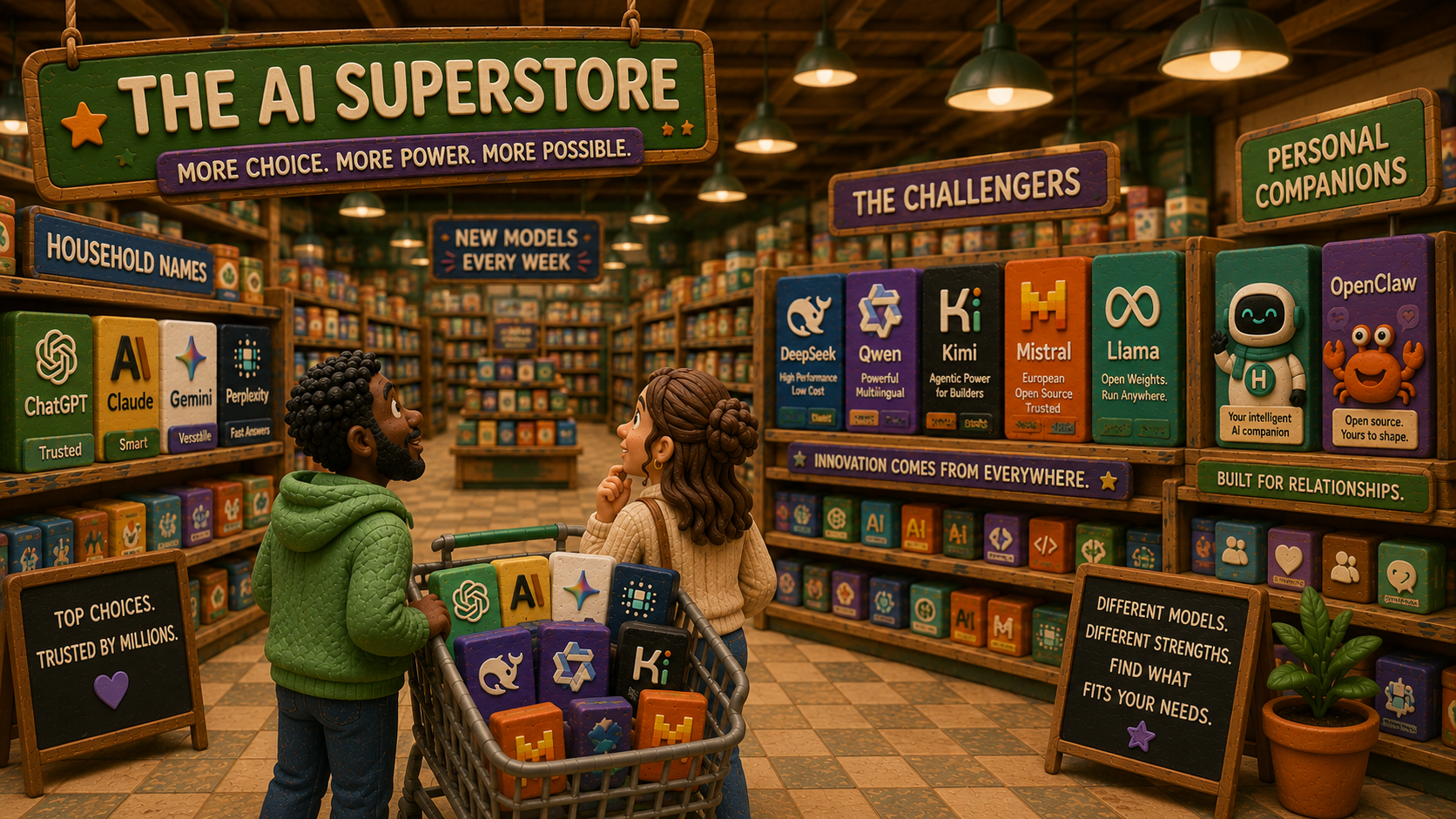
It’s the year 2040. Every human being has an artificial intelligence companion. You give it a name and a personality. When you meet someone new, you no longer ask for their phone number. You ask for their AI’s name and contact. Your AI reaches out to their AI first, the way dogs sniff each other before their owners shake hands.
I wrote that on a bus from Nottingham to London, half as a joke. But the more I sat with it, the more I realised it is not fiction. It is just slightly ahead of schedule.
We are already at the point where choosing an AI is a real decision most people are not making carefully enough. The market has exploded. It is no longer just three American tech giants. There are models coming out of China, Europe, and research labs you have probably never heard of, many of them free, many of them genuinely impressive. And sitting on top of all of them is an emerging category: personal AI companions you can name, configure, and shape around your actual life.
So, lets go window shopping. This is your map of the store. Let’s walk through it.
The Landscape Is Bigger Than You Think
Most people’s mental model of AI in 2026 still goes: ChatGPT, Claude, Gemini. Pick one. Done.
That is like walking into a city full of restaurants and only knowing about three chains. It is not wrong exactly, but it misses most of what is actually available.
In Q1 2026 alone, over 255 model releases came from major organisations. That is not a trend. That is a structural shift in how fast AI capabilities are moving. The question for anyone paying attention is no longer which model is best. It is which model is best for your budget, your use case, and how you want to work.
So let’s break the store into sections.
Section One: The Household Names

You know these. ChatGPT from OpenAI, Claude from Anthropic, Gemini from Google. All four major standard subscriptions, ChatGPT Plus, Claude Pro, Google AI Pro, and Perplexity Pro, have converged at $20 a month. The industry has found its psychological anchor and is now competing on capability, not price.
Each has a distinct personality. ChatGPT is the generalist. Claude thinks more carefully and writes better. Gemini is the one that lives inside your Google apps. Perplexity is less a chatbot and more an AI-powered research engine that cites everything it says. If you only want one tool and you want it to work immediately with no setup, this is your aisle.
Section Two: The Challengers Worth Knowing

This is where it gets interesting.
DeepSeek came out of China in early 2025 and rattled the entire industry by matching frontier-level performance at a fraction of the cost. DeepSeek V3.2 delivers roughly 90 percent of GPT-5.4’s performance at about 1/50th the price. There is no monthly subscription. Web chat is free. API access runs on per-token pricing that significantly undercuts the Western providers. If you are a developer or a technically curious user who wants capability without a recurring bill, DeepSeek deserves serious attention.
Qwen is Alibaba’s model family, and it has quietly become one of the most significant players in the global AI landscape. By April 2026, Qwen model downloads had approached 1 billion, with the family accounting for over 50 percent of all open-source model downloads worldwide. The series includes strong multilingual and coding capabilities, with specialised variants for code generation and mathematical reasoning. Qwen Chat is free with no request limits. The open-weight models can be self-hosted entirely for free. For anyone building with AI or needing strong non-English language support, this is one of the most underrated options in the room.
Kimi is from Moonshot AI, a Chinese lab backed by Alibaba. The latest release, Kimi K2.6, is an open-weight trillion-parameter model that leads on agentic and coding benchmarks, competing directly with GPT-5.4 and Claude Opus 4.6. Its Agent Swarm system can coordinate up to 300 specialised sub-agents running up to 4,000 coordinated steps in a single autonomous run. Kimi is less of a consumer chatbot and more of a serious capability platform, but it is worth knowing about as the space evolves.
Mistral is a French AI company that matters for a specific reason: it is European, open-source, and Apache-licensed, which means anyone can use, modify, and deploy it commercially with minimal restrictions. Mistral Large 3 runs on 675 billion total parameters and ships under Apache 2.0. For businesses or individuals with data privacy concerns, or anyone who prefers their AI infrastructure to sit outside US or Chinese jurisdiction, Mistral is the principled choice.
Meta’s Llama is the open-weight model that changed what free actually means in AI. Llama 4 Scout offers an industry-leading 10 million token context window and outperforms previous-generation models across a broad range of benchmarks. You can run it locally, fine-tune it, and build on top of it. Meta does not sell you a subscription. It just releases the weights and lets the world build.
Section Three: The Personal Companion Layer

This is the aisle most people walk past without realising what they are looking at.
Everything in Sections One and Two is a model. A brain. It answers questions, generates text, reasons through problems. But it does not know your name unless you tell it every time. It does not always remember your projects, your goals, or how you like to communicate. Every conversation potentially starts from zero.
Personal AI companions are built on top of these models. Platforms like Hermes and OpenClaw let you configure an AI agent with a defined personality, persistent memory, a name you choose, and a specific role inside your life or work. The agent carries context. It develops something that starts to feel like familiarity. Over time it becomes genuinely more useful because it knows how you operate.
Here is the nuance that matters: Hermes and OpenClaw are not AI themselves in the way that Claude or Kimi is. They are the shell, the interface, the structure. The AI brain powering them still comes from the model families above. You choose which one. That is a real decision with real consequences, because the quality and personality of your companion depends entirely on the brain you put inside it.
This is actually what makes the shopping metaphor work so well. Choosing a personal AI companion is a two-step process. First you choose the platform, the body. Then you choose the model, the mind. A well-configured agent running on a strong open model like Qwen or DeepSeek can be just as capable as anything you pay $20 a month for, and far more personal.
The year 2040 version I imagined on that bus, where you introduce your AI the way you introduce a person, is just the logical endpoint of what is already being built. The infrastructure exists. The models exist. The companion platforms exist. Most people just have not connected the dots yet.
FAQ
Do I need to pay for AI, or are the free options good enough in 2026?
For most people, free is more than enough to start. Google Gemini’s free tier includes Deep Research, voice mode, and 100 monthly video generation credits, making it the most generous free tier of any major provider. Qwen Chat is free with no request limits. DeepSeek’s web interface is free. Meta’s Llama models can be run locally at no cost at all. The paid tiers make sense when you are using AI daily for work and hitting limits, or when you need the most capable models for demanding tasks.
What is the difference between a general AI tool and a personal AI companion?
A general AI tool is a model you interact with directly. It is capable, responsive, and resets between sessions. A personal AI companion is an agent built on top of a model, configured with memory, personality, and context specific to you. The model is the brain. The companion platform is how you give that brain a consistent identity and working relationship with your life. You need both to build a true companion. Either one alone is just a tool.
Which AI model should I use as the brain for a personal AI agent?
It depends on your priorities. Claude and GPT are strong general options with polished APIs. Qwen offers dramatically lower pricing at comparable quality for a wide range of tasks, making it an attractive option for anyone building agents at scale. DeepSeek is the cost-efficiency leader. Mistral is the choice if open-source licensing and European data jurisdiction matter to you. There is no single right answer, which is exactly why it is worth understanding the full landscape before you decide.
The window is already open. Most people just have not looked through it yet.
The AI market in 2026 is not a choice between three subscriptions. It is a global ecosystem of models, platforms, and emerging companion experiences at every price point from free to enterprise. The shopping metaphor I started with on that bus holds up better than I expected. Different budgets, different needs, different personalities. Some people want the reliable high-street option. Some want to explore the independent side streets. Some want to build something entirely their own.
All of those options exist. You just have to know where to look.


Leave a Reply