

This year might be the year personal computers stop moving in trickles and take one giant leap forward. Nvidia just announced RTX Spark, a new superchip it is putting directly into laptops and desktops, and it might be the most significant thing to happen to the personal computer in decades. Not because it is faster. Because for the first time, your laptop could run a genuinely capable AI agent locally, without sending a single byte to the cloud.
The announcement came at Computex 2026 in Taipei on May 31st. Jensen Huang, Nvidia’s CEO, was on stage with a line that has been quoted everywhere since: “For forty years, you launched apps. Click. Type. With RTX Spark and Microsoft Windows, you ask and the PC does the work.” That is either marketing poetry or a genuine inflection point. After digging into what RTX Spark actually is and how it works, I think it is closer to the second one.
What RTX Spark Actually Is

RTX Spark is a superchip, which means it combines two things that have traditionally lived on separate pieces of silicon: a CPU and a GPU, fused into a single package. The CPU side is a 20-core Arm-based Grace processor, co-developed with MediaTek. The GPU side is built on Nvidia’s Blackwell architecture, the same generation powering their most advanced data centre hardware right now.
What makes this different from a standard laptop chip is the memory. RTX Spark supports up to 128GB of unified memory, shared dynamically between the CPU and GPU depending on what the workload needs. On a regular laptop, your CPU has its own memory pool and your GPU has its own, and they do not talk to each other efficiently. Here, it is one big pool. That matters enormously for running AI models, because large language models are memory-hungry. The reason most people cannot run capable AI locally today is not really processing speed. It is that their machine runs out of memory before the model can do anything useful.
With 128GB unified and 1 petaflop of AI compute, RTX Spark can run a 120-billion-parameter language model locally with up to 1 million tokens of context. To put that in perspective, most cloud AI tools you use today are running models in that ballpark, and they are doing it on server racks in a data centre somewhere. RTX Spark puts that on your desk.
Microsoft’s Role in This
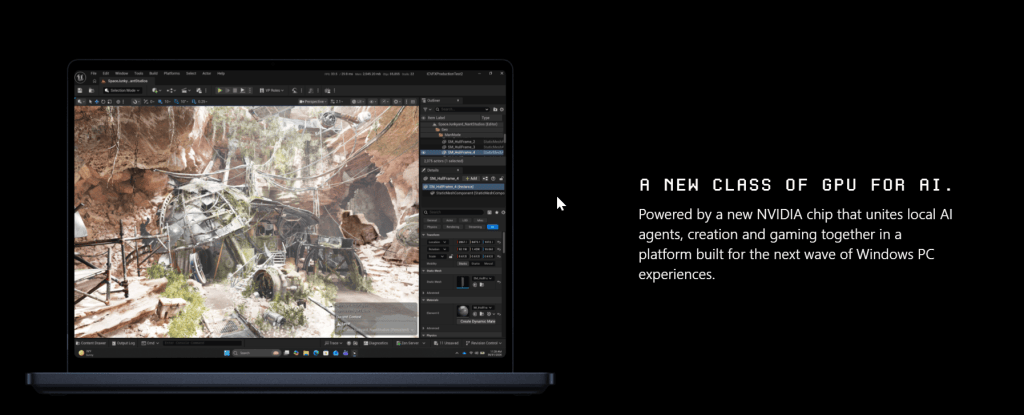
This is not just a chip announcement. Microsoft is a full partner in the launch, and that partnership goes deeper than just putting the chip inside a Surface device.
The two companies have built a new security and agent framework directly into Windows. It starts with new Windows security primitives, which are OS-level building blocks that give AI agents a proper identity, a containment environment, and policy controls. On top of that sits Nvidia’s OpenShell runtime, which lets you define exactly what your agent can and cannot access, routes queries to local or cloud models based on your privacy preferences, and masks personal information before anything leaves your device.
Microsoft is launching its own device built on RTX Spark called the Surface Laptop Ultra. It features the RTX Spark chip, up to 128GB of RAM, a mini-LED display, and a chassis that sits at 14 millimetres thin. Pricing has not been announced yet. Other manufacturers building RTX Spark devices include Dell with the XPS 16 Creator Edition, HP with a new OmniBook line, Lenovo, ASUS, and MSI. All of them are expected this autumn.
Where OpenClaw and Hermes Agent Come In
Back in March, Nvidia announced NemoClaw, a security wrapper that installs on top of OpenClaw in a single command and adds the sandboxing and privacy controls that enterprises need before they can trust an agent with real data. That was the first partnership between Nvidia and the OpenClaw ecosystem.
What happened at Computex is the next layer. Both OpenClaw and Hermes Agent are building dedicated Windows applications that run natively on RTX Spark hardware, with OpenShell baked in. These are not the terminal-based, developer-facing tools you would run on a VM today. They are consumer-facing Windows apps that sit in your taskbar, connect to your files and applications, and operate within the security framework Microsoft and Nvidia have built into the OS itself.
The practical difference is significant. Running OpenClaw on a VM or a standard laptop today means broad system access by default, manual security configuration, and memory limits that cap what models you can actually run. On an RTX Spark machine with native Windows integration, the agent has enough memory to run frontier-sized models locally, the security containment is handled at the OS level rather than something you set up yourself, and it can move between your applications natively rather than through workarounds.
What This Means for You
If you use AI tools regularly, you have probably noticed that everything interesting requires an internet connection and a subscription. The reason is simple: the models powerful enough to be genuinely useful have not been able to run on consumer hardware. RTX Spark changes that calculus in a meaningful way.
I have been running AI agents on a Hetzner server for several months. The friction is real. There is a latency, a dependency on uptime, and an awareness that everything is happening somewhere else on hardware I do not own. The agents are useful but they feel tethered. What Nvidia is describing with RTX Spark is the version of that experience where the agent is sitting on the machine in front of you, working with your actual files, inside your actual applications, without a cloud round trip on every request.
The privacy angle matters too. If your agent is reasoning over your documents, your calendar, and your email, having that happen locally on your hardware rather than on a server you do not control is not just a performance preference. It is a meaningful difference in who has access to your data.
FAQ
What is Nvidia RTX Spark and how is it different from a normal laptop chip? RTX Spark is a superchip that combines a 20-core CPU and a Blackwell RTX GPU in a single package with up to 128GB of unified memory shared between them. Unlike a standard laptop chip where CPU and GPU memory are separate, RTX Spark’s unified pool allows it to run large AI models locally that would normally require a cloud server, while also handling gaming, video editing, and creative workloads in the same device.
Can I actually run AI agents locally on my laptop with RTX Spark? Yes, and that is the core point of the chip. RTX Spark can run 120-billion-parameter language models with up to 1 million tokens of context without a cloud connection. Combined with the native Windows integration and apps from OpenClaw and Hermes Agent, the experience is designed to be a proper consumer product rather than a developer setup requiring technical configuration.
When will Nvidia RTX Spark laptops be available and how much will they cost? RTX Spark laptops and compact desktops are expected this autumn from ASUS, Dell, HP, Lenovo, Microsoft Surface, and MSI, with Acer and GIGABYTE models to follow. Pricing has not been officially announced for any of the devices yet, including the Surface Laptop Ultra, though given the hardware specifications these are expected to sit at the premium end of the market.

The Bigger Picture
The PC has been incremental for a long time. Faster chips, thinner chassis, better displays. Useful, but not the kind of change that makes you rethink what a computer is for. RTX Spark feels like a different category of announcement because it is not just about hardware specs. It is about where the intelligence lives. If it works as described, the shift from asking a cloud service to ask your own machine is not a minor convenience upgrade. It is a different relationship with your tools entirely.
The devices are not in people’s hands yet. Announcements are not products. But the direction is clear, and autumn 2026 is not far away.
If you want to follow how this actually lands when the hardware ships, and how AI agents on local hardware compare to what we can build right now, subscribe to The August Dispatch at newsletter.augustwheel.com. That is where I write about this stuff as I test it, not after everyone else has already moved on.




Leave a Reply